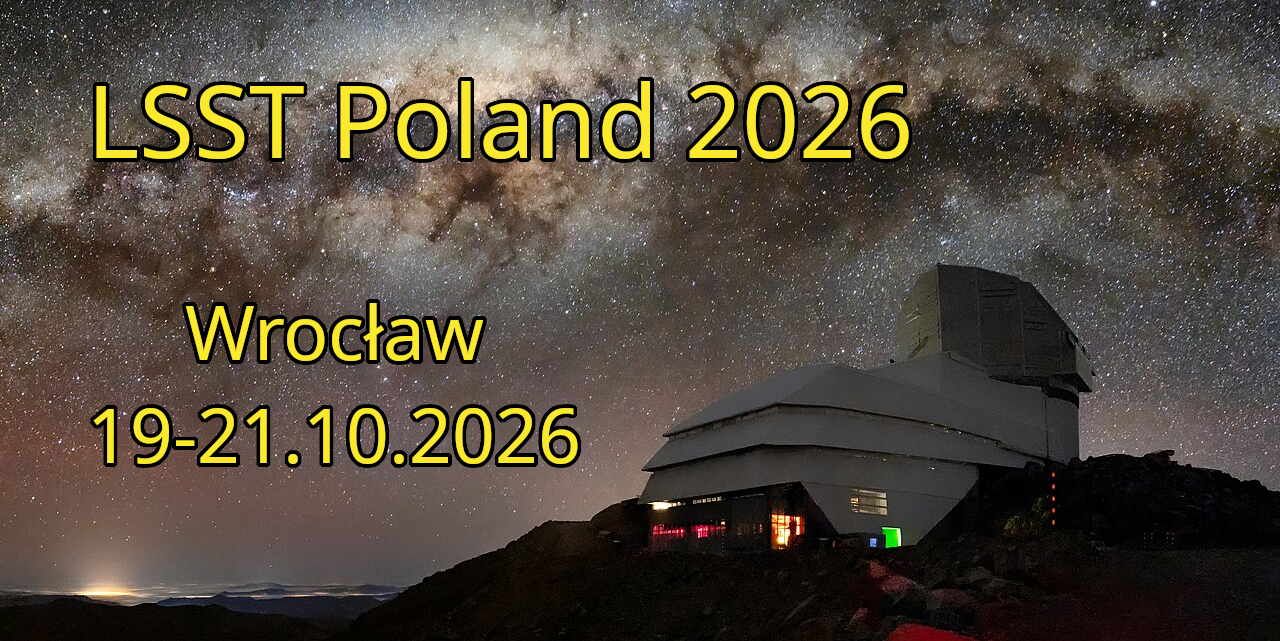
The Rubin-LSST Polish Consortium Annual Meeting 2026

→ Europe/Warsaw
Uniwersytet Wrocławski, Instytut Astronomiczny, Kopernika 11, 51-622 Wrocław, Poland
Description

The rationale

The Legacy Survey of Space and Time (LSST) has now officially begun at the NSF–DOE Vera C. Rubin Observatory in Chile. Following the successful completion of commissioning and early operations, the observatory has entered its planned 10-year survey, repeatedly imaging the entire southern sky with the world's largest digital camera. LSST is expected to produce an unprecedented time-domain dataset that will transform research on dark matter, dark energy, the Solar System, transient phenomena, and the structure of the Milky Way, while generating millions of real-time astronomical alerts each night.

To foster collaboration within the Polish LSST community and share early scientific and technical experience with LSST data, a two-day conference will be held on 19–20 October in Wrocław. The meeting will provide a forum for participants to exchange their first experiences working with LSST data, present initial scientific results, and discuss emerging analysis techniques and challenges. An optional hands-on workshop will follow on Wednesday, October 21, offering participants practical training in accessing, exploring, and analyzing LSST data and introducing the tools and workflows used within the LSST data system.
 

SOC:

LOC:

• Katarzyna Małek (NCBJ, chair) • Andrzej Pigulski (IA UWr, chair)
• Agnieszka Kryszczyńska (UAM) • Orest Dorosh (NCBJ)
• Agnieszka Pollo (NCBJ) • Piotr Kołaczek-Szymański (IA UWr)
• Maciej Bilicki (CFT PAN) • Paulina Góra (IA UWr)
• Paweł Pietrukowicz (OA UW) • Piotr Łojko (IA UWr)
  • Wojciech Niewiadomski (IA UWr)


    • 09:40 → 10:00
      Welcome
      • 09:40
        Welcome 20m
        Speakers: Prof. Agnieszka Pollo (NCBJ), Prof. Andrzej Pigulski (Institute of Astronomy, Faculty of Physics and Astronomy)
    • 10:00 → 11:00
      Session 1
      • 10:00
        Rubin Observatory: status and early science 45m
        Speaker: Prof. Greg Madejski (SLAC)
      • 10:45
        Halo Occupation Distribution estimation for the upcoming LSST data 15m

        The next generation of surveys, in particular the Rubin Observatory Legacy Survey of Space and Time (LSST), will enable high signal-to-noise measurements of galaxy clustering across a broad range of environments and cosmic scales. The halo occupation distribution (HOD) framework provides a powerful statistical link between galaxies and the dark matter structures and is key to testing galaxy formation models and constraining cosmology. Robust methods to estimate the HOD are therefore essential.
        In this work, we evaluate the performance of an HOD estimation algorithm tailored for deep photometric surveys. We extend a halo-based group finder, originally designed to combine spectroscopic and photometric data, to operate using imaging data and photometric redshifts alone. Using a realistic mock galaxy survey from the cosmoDC2 catalogue, we implement a background subtraction technique to mitigate projection effects and apply an iterative centroiding method to improve group center identification.

        We assess the method’s ability to recover halo populations using completeness and purity metrics. Our results provide a quantitative benchmark for HOD reconstruction in LSST-like data, demonstrating the potential of photometric surveys to map halo population. This approach contributes to ongoing efforts to connect galaxy populations to their evolving large-scale environments in the era of multiwavelength survey synergy.

        Speaker: Dr Maria Antonela Taverna (NCBJ)
    • 11:00 → 11:30
      Coffe break 30m
    • 11:30 → 12:15
      Session 2
      • 11:30
        Magnification bias for cross-correlation of CMB lensing and galaxy clustering in LSST 15m

        Cosmology is currently in a period of rapid development. During the past decade, increasing observational evidence has led to the establishment of the LCDM model. Despite its success, the latter has recently been challenged by several tensions. The combination of galaxy surveys and CMB lensing is a powerful probe of the large-scale structure and a key tool for testing the standard cosmological model in the era of next-generation experiments. Upcoming galaxy surveys such as the Legacy Survey of Space and Time (LSST), together with CMB experiments such as the Simons Observatory (SO) and LiteBIRD, will dramatically improve the volume of the available data. On the on the other hand, such surveys will also require careful control of increasingly important observational systematics. One important effect is magnification bias, arising from lensing-induced fluctuations in observed galaxy number counts. While previous studies focused on low redshift galaxy clustering and clustering-shear cross-correlations, I will show that magnification bias grows dramatically for the higher redhsifts probed by LSST. In particular, I will present studies of the effect on the CMB lensing-galaxy clustering cross-correlation following a novel tomographic approach. Understanding and mitigating magnification bias will be crucial to fully exploit LSST data, and to shed light on the unresolved cosmological tensions.

        Speaker: Nicola Principi Cavaterra (NCBJ)
      • 11:45
        Impact of the systematic effects on the modified gravity and cosmological model constraints. 15m

        The combination of the data from upcoming large-scale structure surveys - such as the Rubin Observatory Legacy Survey of Space and Time (LSST) - and CMB lensing experiments - like the Simons Observatory - offers a powerful tool to test deviations from ΛCDM. The robustness of these tests depends on our understanding of observational and astrophysical systematics. In this talk, I will present an investigation into the systematic effects that can have influence on robustness of constraints on modified gravity and cosmological models. Specifically, I will focus on likelihood-based analyses and the biases introduced by photometric redshift errors in galaxy surveys.

        Speaker: Paweł Siegmund (NCBJ)
      • 12:00
        HAWC detection of SNR W28 10m

        The W28 supernova remnant is a promising site for studying the acceleration and propagation of Galactic cosmic rays. Its proximity to dense molecular clouds provides a natural environment for cosmic-ray interactions and γ-ray production. We use data from the High-Altitude Water Cherenkov (HAWC) Observatory to investigate the very-high-energy (VHE; >100 GeV) γ-ray emission from the W28 region. We characterize the morphology of the emission and compare its spatial distribution with the surrounding molecular-cloud environment. HAWC detects significant VHE γ-ray emission from the region, providing an opportunity to probe the connection between the SNR, cosmic rays, and nearby molecular material. Our analysis aims to constrain the origin and propagation of the particles responsible for the observed γ-ray emission.

        Speaker: Suvendu Giri (The Henryk Niewodniczański Institute of Nuclear Physics Polish Academy of Sciences)
    • 12:15 → 14:15
      Lunch 2h
    • 14:15 → 15:00
      Session 3
      • 14:15
        Red disk-like galaxies in the large scale structure 15m

        Spiral galaxies are typically classified as star-forming, which is associated with their blue color. They are usually found in less dense regions. Their counterparts, red elliptical galaxies, which are usually passive, are typically found in overdense regions. Red and disk-like galaxies, on the other hand, are passive but retain a spiral disk structure. These galaxies are relatively rare, and their origin and place in the cosmic web are still debated. Some researchers find that their clustering properties are similar to those of passive ellipticals, while others find that they prefer underdense regions.

        In this talk, we will present studies on the nature and location of red disk-like galaxies in the cosmic web as observed in the VIPERS survey. Additionally, we will examine their clustering properties and explore how they can be studied using upcoming LSST data.

        Speaker: Dr Anna Durkalec (National Centre for Nuclear Research)
      • 14:30
        Low Surface Brightness galaxies in the early Rubin data 15m

        The standard pipeline and deblender for LSST use techniques that are not ideal to the characterization of Low Surface Brightness galaxies and features. Of particular concern and interest to us, are issues of shredding and improper centroiding for LSB galaxies which leads to the standard pipeline catalogs becoming unreliable when searching for these objects. The alternative of re-doing the photometry across the LSST data release footprints in order to make them more LSB-friendly, would be an extremely resource-intensive task which may not be accessible at present to the community. Which also makes it time and labour intensive to obtain an appropriate training set that can be used to calibrate machine learning techniques for LSB science. Through a combined use of additional operations on the LSST catalog products and the deployment of transfer learning techniques, we are working to post-process the standard catalogs from Data Preview 1 and 2 to identify and detect LSB galaxy candidates. This would be an accessible alternative for most users of the Rubin Science Platform and would allow us to start building a statistical sample of LSB galaxies in the LSST footprint. If possible, I look forward to presenting my work which focuses on searching for and identifying LSB galaxies in the early data releases of Rubin (Data Preview 1 and 2).

        Speaker: Dr Nandini Hazra (NCBJ Warsaw)
      • 14:45
        Tracing the environments of low-surface-brightness galaxies 15m

        Low-surface-brightness galaxies (LSBGs) provide important insights into galaxy formation and evolution, yet the role of the environment in shaping their properties remains poorly understood. Using a sample of ~ 20,000 LSBGs from the Kilo-Degree Survey (KiDS), we investigate how their spatial distribution depends on colour and morphology. We quantify their clustering with the angular two-point correlation function and use Limber inversion with the redshift distribution to infer spatial correlation lengths. We find that red LSBGs cluster substantially more strongly than blue LSBGs. Moreover, featureless galaxies exhibit the strongest clustering, spirals the weakest, and ellipticals intermediate clustering amplitudes. Additionally, for all LSBGs samples at small angular separations, we observe a significant flattening of the correlation function with respect to both high surface brightness galaxy measurements and power-law models. This suggests that LSBGs distribution in clusters differs from that of high surface brightness galaxies, and that there may exist environmental processes that prevent LSBGs from forming in cluster centres.
        Our results provide new constraints on the relationship between LSBG properties and their environments. Future surveys, particularly the Vera C. Rubin Observatory's Legacy Survey of Space and Time (LSST), will help us study these relationships with substantially larger samples and greater statistical precision.

        Speaker: Henry Willems (NCBJ)
    • 15:00 → 15:30
      Coffe break 30m
    • 15:30 → 16:15
      Session 4
      • 15:30
        The HYADES Mission in the LSST Era 15m

        The origin of Earth's water and its distribution throughout the Solar System remain among the key questions in modern planetary science. The planned Hydrogen and Deuterium Survey (HYADES) space mission will address these questions through highly sensitive observations of water in small Solar System bodies, enabling the detection of even trace amounts of water, as well as measurements of the D/H ratio in water-rich comets to investigate its origin and evolution. LSST is expected to increase the number of known small Solar System bodies by nearly an order of magnitude, significantly expanding the sample of known main-belt comets and increasing the discovery rate of interstellar objects. These discoveries will provide HYADES with a much larger and more diverse pool of potential observational targets, opening new opportunities to search for water in previously unexplored populations. Furthermore, LSST's high sensitivity and regular observing cadence will enable the detection of fainter cometary activity and the monitoring of its evolution over time. Earlier identification of potential targets could be particularly valuable for HYADES, allowing observations to be planned during periods of peak activity and under the most favorable observing conditions. We will discuss the opportunities that LSST will open up for the HYADES mission.

        Speaker: Mr Szymon Ryszkowski (Jagiellonian University)
      • 15:45
        Bringing the Rubin Observatory and LSST to Schools: Space STEM Workshops across Greater Poland 15m

        "The “Space Workshop Days” project is a regional STEM outreach initiative bringing modern astronomy, space science, and technology directly to secondary-school students across Greater Poland, Poland. Funded by the Local Government of the Greater Poland Region and coordinated by the Earth and Space Foundation in collaboration with Adam Mickiewicz University and Poznań University of Technology, the project comprises seven full-day educational events reaching approximately 630–840 students aged 14–19.

        A central element of the programme is the promotion of the Vera C. Rubin Observatory and its Legacy Survey of Space and Time (LSST). Through hands-on activities using Rubin Comet Catchers, students work with astronomical images and learn how large-scale sky surveys can be used to discover and study comets and other Solar System objects. Complementary workshops introduce satellite Earth observation using Sentinel data, robotics, programming, and automation.

        By connecting authentic scientific data with practical activities and direct interaction with researchers, the project introduces students to contemporary astronomy and highlights educational and career opportunities in STEM and the space sector. Particular emphasis is placed on reaching young people outside major academic centres and increasing awareness of LSST and data-driven astronomy throughout the Greater Poland region."

        Speaker: Dagmara Oszkiewicz (Adam Mickiewicz University)
      • 16:00
        4MOST-Rubin few-hundred-megaparsec Hubble-Lemaitre analysis with minimal model dependence 15m

        The goal of this Hubble-Lemaitre flow analysis is to measure the cosmological line element with as few prior model assumptions as possible. The aim will be to use 4MOST followups of LSST-Rubin supernovae type Ia (SNe Ia) light curve analyses together with complementary surveys to infer cosmological parameters for the local few
        hundred megaparsecs of our Universe with as little dependence on model parameters as possible. This approach aims to make no cosmological assumptions beyond the assumption that the Universe is a 4-Lorentzian pseudo-Riemannian manifold satisfying the Einstein equation everywhere. This is a less restrictive hypothesis than modelling via the usual Friedmann-Lemaitre-Robertson-Walker (FLRW) line element.

        Speaker: Boudewijn Roukema ( Institute of Astronomy, Nicolaus Copernicus University )
    • 16:15 → 17:00
      Discussions
    • 09:30 → 10:45
      Session 5
      • 10:00
        Is the statistical analysis of Ultra Diffuse Galaxy possible with LSST? 15m

        Low surface brightness galaxies (LSBs) are estimated to make up around 50% of the total number density of galaxies in the local observable universe. However, they contribute less than 10% of the total luminosity, making them challenging to detect. LSBGs are defined as having an average surface brightness greater than 23 mag/sec2 in the r-band.  An even more extreme subtype of LSBGs are Ultra Diffuse Galaxies (UDGs) - a subtype of LSBGs that are even fainter and larger. Will LSST provide the opportunity and tools for new statistical analyses of these extremely shy objects? What kind of pipeline do we need to develop to analyze the first examples of LSBGs and UDGs? In my talk, I will present the proof of concept for our analysis, starting with classification through flux measurements, spectral energy distribution fitting and environmental studies and addressing the need for spectroscopic follow-up.

        Speaker: Prof. Katarzyna Małek (NCBJ)
      • 10:15
        Testing surface-brightness–colour relations as a dust attenuation proxy with LSST, JWST and HST 15m

        A reliable dust attenuation estimate can be obtained from spectral energy distributions (SEDs) constructed over a wide range of wavelengths, including the ultraviolet (UV) and infrared (IR) regions. It is necessary to account for dust attenuation in order to reliably extract galaxy properties, such as the star formation rate (SFR), stellar ages and evolutionary state. The Legacy Survey of Space and Time (LSST) will provide optical observations of billions of objects. This creates a need for a dust attenuation proxy that uses optical data only. There have been proposals for such methods, but they still require verification from independent tracers. This requires comparing the attenuation estimated from optical data alone with a reference attenuation estimate derived from broad-wavelength SED fitting, including UV and IR data from auxiliary surveys. In this study, we investigate whether surface brightness and colour can predict dust attenuation. In our analysis, we combine observations from the James Webb Space Telescope and Hubble Space Telescope with LSST observations in the overlapping fields, such as GOODS-South and COSMOS-Web, restricting the sample to (z \sim 0.3).

        Speaker: Maja Wiśniewska (Narodowe Centrum Badań Jądrowych)
      • 10:30
        Small grains - big impact on the LSST discoveries? 15m

        The Vera C. Rubin Observatory is currently conducting the largest sky survey in human history: the LSST. It will observe the entire sky every three days for ten years. It will collect astronomical amounts of data and observe nearly 20 billion galaxies. Despite these advantages, LSST observations will range from 338 to 1010 nm, thus leaving us without infrared measurements, which are crucial for correctly estimating the physical properties of galaxies, such as mass and star formation rate (SFR). This raises the question: can we approximate dust attenuation using only six Rubin filters? In this talk, I will attempt to answer this question.

        Speaker: Patryk Matera (Narodowe Centrum Badań Jądrowych)
    • 10:45 → 11:15
      Coffe break 30m
    • 11:15 → 12:15
      Session 6
      • 11:15
        Statust of LSST and Polish consortium 20m

        TBD

        Speaker: Prof. Agnieszka Pollo (National Centre for Nuclear Research AND Jagiellonian University)
      • 11:35
        Measuring the Hubble constant from AGN continuum time delay in LSST data 20m

        Determining the Hubble constant through active galactic nuclei continuum reverberation mapping requires high quality photometric light curves to disentangle physical components near supermassive black holes. Within the framework of the Rubin LSST In Kind Contribution POL NCB S6, we utilize our dedicated HORIZON AGN code software to model continuum light curves and spectral energy distributions. This physically motivated framework incorporates standard Shakura Sunyaev accretion disks, lamppost X ray irradiation, warm coronas, diffuse continuum and line emission from the radiation pressure regulated broad line region, and dusty torus reprocessing. By simultaneously fitting continuum lag spectra and broad spectral energy distributions, HORIZON AGN treats the accretion rate and luminosity distance as free parameters, yielding an independent measurement of the Hubble constant.

        We have successfully applied this framework to two completed sources, archival data of NGC 5548 and our first target Fairall 9 from the Hubble Constant Constraint through AGN Light curve Observations program at Obserwatorium Cerro Murphy, while modeling for a third target is currently in progress. These targets illustrate the light curve quality needed for accurate time delay recovery.

        Looking ahead, the Vera C Rubin Observatory will deliver transformative datasets. For Data Release 2, light curves spanning 6 filters (u, g, r, i, z, y) will benefit from up to a full year of continuous rolling history and forced photometry precision better than 20 milli magnitudes, where 1 mmag equals one thousandth of a magnitude or sub percent flux accuracy. In the LSST Deep Drilling Fields, this photometric precision combined with continuous baseline monitoring will dramatically improve continuum light curve resolution for vast AGN samples. However, applying HORIZON AGN to hundreds of sources requires reducing model free parameters. In this talk, I will present results from our completed and in progress targets, evaluate light curve standards for continuum mapping, and outline our strategy to optimize HORIZON AGN for upcoming Rubin LSST datasets.

        Speaker: Shivangi Pandey (Center for theoretical Physics PAS)
      • 11:55
        Synergistic Science with Rubin and MeerKAT 20m

        Panchromatic data, by combining observations across multiple wavelengths, offer an unparalleled, comprehensive view of galaxies. This enables the determination of key physical properties and leads to discoveries not possible with single-wavelength data alone. While Rubin is preparing to make enormous discoveries in the optical wavebands, the MeerKAT radio telescope in South Africa is providing wide-field radio continuum imaging of the same sky observed by Rubin. These radio continuum observations are crucial as they provide dust extinction-free star formation rates (SFR) of galaxies, as well as the properties of Active Galactic Nuclei (AGN). In this talk, I will present a semi-automated pipeline, developed as a part of the South African in-kind contribution towards the LSST Galaxy Science Collaboration. This pipeline is designed for MeerKAT data reduction, source extraction and cross-matching them with the optical data from Rubin and hence creating a powerful synergistic dataset. The resulting multi-wavelength catalog will be highly beneficial for diverse science cases, including accurate SFR estimation, precise source counts, and detailed radio source clustering analyses. I will also present preliminary results using existing sources extracted from MeerKAT images, cross-matched with the DECaLS optical survey, demonstrating the immediate utility of this approach.

        Speaker: Dr Unnikrishnan Sureshkumar (NCBJ)
    • 12:15 → 14:15
      Lunch 2h
    • 14:15 → 15:20
      Session 7
      • 14:15
        Improved delensing of CMB B-modes with upcoming SO and LSST Year-1 data 20m

        In the era of high-precision Cosmic Microwave Background (CMB) anisotropy measurements, detection of primordial gravitational waves (PGWs) is one of the main goals of current CMB experiments. Detection of a divergence-free (B-mode) component in CMB polarisation will provide direct evidence of inflationary PGWs in the early universe. However, weak gravitational lensing of CMB photons due to intervening mass distribution of the Universe distorts the primordial polarisation patterns, introducing an additional lensing-induced B-mode signal. Removing these lensing-induced B-modes is essential for improving constraints on the amplitude of PGWs. In this work, we test a tomographic delensing method on simulations of the Rubin Observatory LSST galaxy catalogue and Simons Observatory (SO) CMB maps. A significant improvement in delensing efficiency is achieved by using a multi-tracer approach,
        where we split the galaxy dataset into tomographic redshift bins. However, uncertainties in photometric redshift measurements pose a problem for optimal weighting of the tracers. In this work, we set up a pipeline to perform a multi-tracer delensing method and studied the impact of photometric redshift errors, using realistic simulations of LSST galaxy catalogue and SO CMB maps.

        Speaker: Kishan Deka (NCBJ (BP4))
      • 14:35
        Unlocking Non-linear Pairwise Velocities in the LSST Era 15m

        Peculiar velocities provide a complementary probe of large-scale structure by directly tracing the gravitational dynamics of structure formation. Yet observational analyses of pairwise velocities and the pairwise kinetic Sunyaev-Zel’dovich signal remain largely restricted to linear and quasi-linear scales, leaving substantial cosmological information at smaller separations untapped.

        We present a simulation-calibrated likelihood for the mean pairwise velocity, v12(r,a), based on the exact pair conservation equation and non-linear matter clustering, validated against the Quijote and TNG300-3 simulations. Extending the analysis from a linear-regime baseline of 50 Mpc/h down to 4 Mpc/h at z=0.5 reduces the uncertainty on fσ8 by up to 86%, while the joint Ωm–fσ8 Figure-of-Merit improves by up to a factor of 9.1.

        These gains motivate asking how much of this non-linear information can be recovered with LSST-era datasets. LSST will provide dense photometric samples for cross-correlation with spectroscopic and CMB surveys, while photometric redshift uncertainties, tracer selection and galaxy velocity bias complicate the interpretation of small-scale pairs. Our framework provides a controlled starting point for quantifying these effects and determining the scales on which non-linear pairwise motions can become a practical cosmological probe.

        Speaker: Dr Mariana Jaber (NCBJ)
      • 14:50
        A Redshift-Limited Sample Selection and Photometric Redshift Estimation for 4MOST WAVES: Prospects for LSST 15m

        In this talk, I will present a machine learning-based approach to select a redshift-limited sample using multiband photometry when spectroscopic redshifts are not available. The technique is a decision tree-based binary classification, which has been further extended into a photometric redshift estimation method. This selection methodology has been applied to select targets for the WAVES survey of the Multi-Object Spectroscopy Facility (4MOST). WAVES has a key science goal of probing the halo mass function to fainter magnitudes compared to previous surveys like GAMA. The ML selection method achieves completeness of over 90%, as desired by the survey. We demonstrate that our method achieves photo-z scatter σ_NMAD ~ 0.015 when tested against the DESI DR1 sample flux-limited to 21.2 in Z-band magnitude.

        This sample selection and photometric redshift estimation methodology can be successfully applied to a large photometric survey like LSST, and we see it as a potential contribution to the LSST DESC photo-z community.

        Speaker: Gursharanjit Kaur (Center for Theoretical Physics, PAN)
      • 15:05
        Cosmology with quasars in Kilo-Degree Survey 15m

        I will present my current work on cosmological inference with quasars (QSOs) from the Kilo-Degree Survey (KiDS). In both the classification and the photometric redshift (photo-z) steps, I test how far the models can be extrapolated beyond the coverage of the spectroscopic training data, and how the resulting errors propagate into the cosmological constraints. I compare ML methods for uncertainty estimation in QSO photo-z, and describe the calibration of the classification and photo-z results with self-organising maps (SOMs). Finally, I present preliminary constraints from the KiDS QSO samples, obtained with tomographic binning in photo-z. Both the methods and the results carry over directly to LSST, which will deliver quasar samples that are larger and deeper, but even less well covered by spectroscopic training data.

        Speaker: Dr Szymon Nakoneczny (CFT PAN)
    • 15:20 → 15:50
      Coffe break 30m
    • 15:50 → 16:35
      Session 8
      • 15:50
        Deciphering the Formation Scenarios of Blue Stragglers Using Asteroseismology 15m

        Modelling blue straggler stars (BSSs) is a challenging task because they undergo non-single-star formation and evolution. Several formation scenarios have been proposed, but disentangling which pathway is responsible for the formation of a given BSS is not straightforward.

        Two steps could significantly improve our understanding of these intriguing objects. Firstly, we need observables and methods that can place stringent constraints on the internal structure and evolutionary history of BSSs.
        This can be achieved by applying asteroseismology to pulsating BSSs (e.g. SX Phoenicis variables), by exploiting oscillation modes that carry information about otherwise inaccessible regions of stars.
        Secondly, we need to identify as many pulsating BSSs as possible from observational data across a wide range of stellar clusters. The multi-colour photometry from the Legacy Survey of Space and Time (LSST) has great potential to advance studies of BSSs by providing excellent data for extracting pulsation frequencies and identifying pulsation modes.

        Here, we present our current results from asteroseismic modelling of BSSs and discuss the prospects for identifying BSSs in various stellar clusters from colour–magnitude diagrams using the LSST passbands.

        Speaker: Prof. Jadwiga Daszyńska-Daszkiewicz (University of Wroclaw)
      • 16:05
        Mode Identification in Blue-Straggler Pulsators with LSST Multicolour Photometry 15m

        As LSST will probe faint and distant stellar populations, it offers an unprecedented opportunity to study pulsating blue stragglers, particularly SX Phoenicis stars in stellar clusters. Mode identification is a crucial step in asteroseismic modelling, which can provide constraints on the internal structure and evolutionary history these stars. Photometric method of mode identification exploits the fact that the wavelength dependence of pulsation amplitudes and phases varies with the mode geometry. We present various diagnostic diagrams for the models of blue stragglers
        in the LSST passbands and assess their potential for mode identification.

        Speaker: Dr Wojciech Szewczuk (University of Wrocław)
      • 16:20
        BHTOM telescope network for LSST time-domain follow-up 15m

        The Rubin's LSST will transform time-domain astronomy while creating an unprecedented demand for rapid and sustained follow-up observations. BHTOM.space —the Black Hole Target and Observation Manager—coordinates a global network of nearly 200 professional and amateur telescopes and provides automated processing, calibration, and standardisation of heterogeneous photometric data. Originally developed to support Gaia Science Alerts, BHTOM now covers a broad range of transient and variable phenomena, including microlensing events, supernovae, stellar variability, quasars, and Solar System objects. In this talk, I will present the network’s capabilities, recent science applications, preparations for Rubin/LSST alert-driven observing and the connections to LSST brokers. I will also discuss how BHTOM can connect LSST discoveries with distributed follow-up resources, turning observations from diverse instruments into consistent, science-ready light curves and enabling coordinated participation by the Polish and international small-telescope communities.

        Speaker: Prof. Lukasz Wyrzykowski (National Centre for Nuclear Research/University of Warsaw Astronomical Observatory)
    • 16:35 → 17:15
      Discussions
    • 09:30 → 12:30
      Workshop
      Conveners: Greg Madejski, Nandini Hazra
Your browser is out of date!

Update your browser to view this website correctly. Update my browser now

×